
Public proofs
Inspect shareable reconciled operation records without connecting a wallet or paying fees.
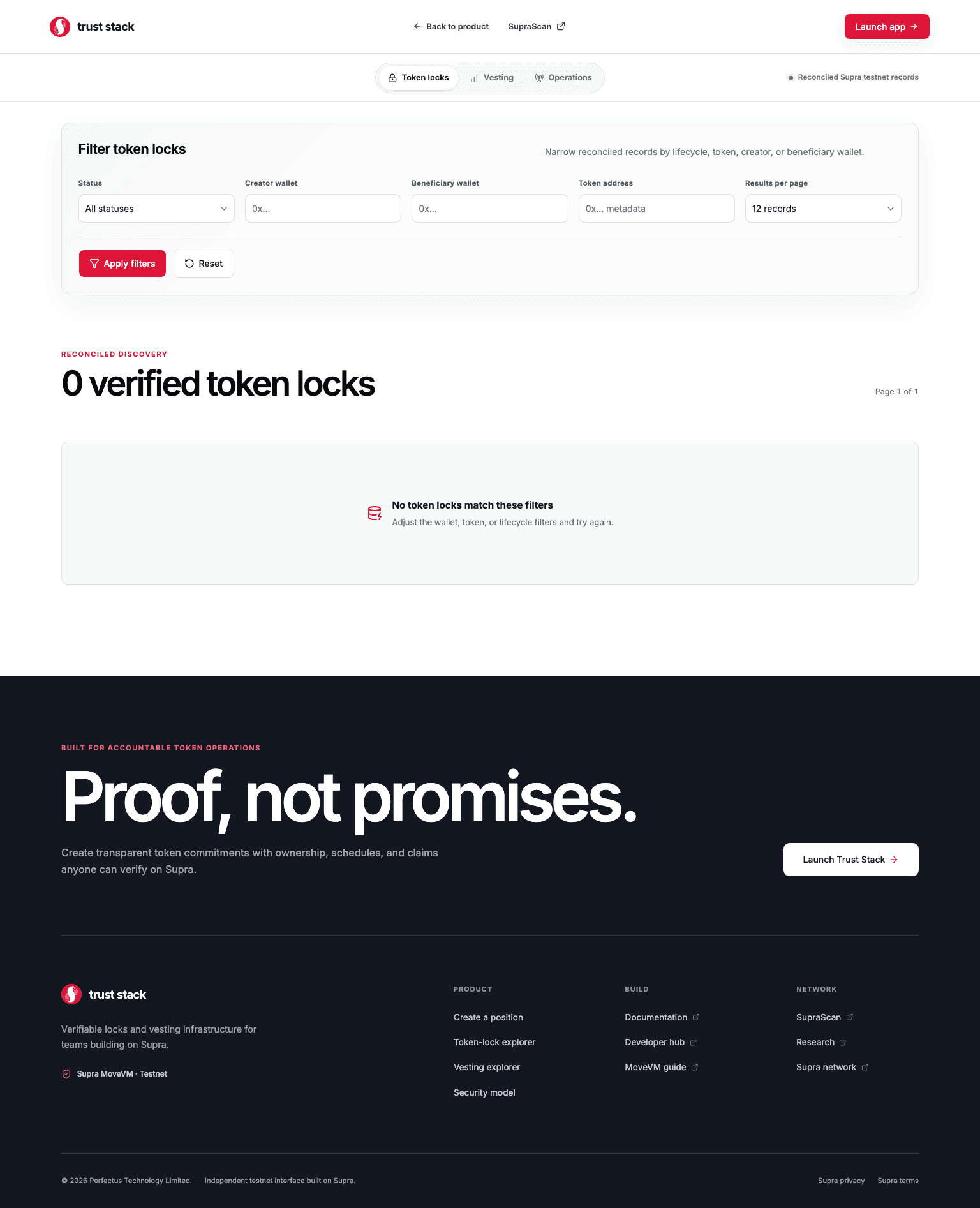
Public proofs are read-only views of recognized Trust Stack events. Beneficiaries, project teams, auditors, and partners can inspect a record and its transaction without connecting a wallet or granting account access.
When to use them
Use a public proof to:
- share evidence that a recognized creation, claim, cancellation, or other operation was reported;
- locate the entity object and SupraScan transaction;
- compare participants, asset, amount, and lifecycle data; or
- support an audit or customer-support investigation without requesting wallet access.
A public proof is not a substitute for current on-chain state or an independent consensus proof.
Browse records
- Open Public proofs.
- Select token locks, vesting, or operations.
- Filter by status, creator, beneficiary, asset, operation type, or bounded page size.
- Open the exact record and compare its full addresses and amount.
- Follow the SupraScan link to inspect the source transaction.
- If an action is required, continue to the product management page and reread current Move state.
Practical example
A project tells Alice that 100,000 EXR was locked for her. Alice can open the public token-lock
proof, filter by her beneficiary address, and verify:
- the creator and beneficiary;
- the EXR metadata address;
- the
100,000 EXRamount and unlock time; - the lock object and creation transaction; and
- whether the indexed lifecycle currently shows claimed or unclaimed.
Alice does not connect StarKey to browse. When she later claims, the claim page performs fresh authoritative reads and the normal token-lock claim cost applies.
Fees and costs
| Action | Trust Stack protocol fee | Network gas |
|---|---|---|
| Browse, filter, or share a public proof | None | None |
| Open a SupraScan transaction | None | None |
| Submit a claim or management action | Depends on the underlying product | Transaction signer pays gas |
Viewing is an ordinary HTTPS read and does not require a wallet transaction. Public proofs never ask for a seed phrase or private key. For an underlying action, check that product's Fees and costs section; currently vesting claims charge 1%, while fixed-lock, stream, airdrop, staking, Digital Asset-lock, and LP-lock claims have no Trust Stack protocol fee.
What is reconciled
The indexer validates a known event schema, canonicalizes addresses and unsigned integers, and stores:
- event type and original payload;
- transaction hash and block dimensions;
- normalized entity, participants, asset, and amount; and
- the configured RPC's emission-proof fields and event hash.
Unknown fields, malformed addresses, unexpected event types, and mismatches between the event hash and the leaf returned in the same RPC response fail ingestion instead of appearing as reconciled records.
What a public proof does not prove
- that the frontend or configured RPC is uncompromised;
- current position, vault, owner, balance, or claimable state;
- independent Merkle inclusion into an authenticated block root;
- consensus finality independently of the configured RPC;
- token issuer, wallet, DEX, or package-upgrade safety; or
- that an independent smart-contract audit has approved the product.
Use the proof to establish what the configured RPC reported and what the indexer reconciled. Use current Move views to authorize any transaction.
Common problems
- No record found: confirm chain, full address, transaction success, and indexer progress.
- Similar token name: compare the complete metadata address.
- Proof says unclaimed but wallet action disagrees: current on-chain state takes precedence.
- Someone requests wallet secrets to verify: stop; public browsing needs no wallet access.
- Need stronger evidence: inspect the source transaction and independent RPC or chain evidence.
Read-only by design
Public proofs do not sign transactions, hold funds, or grant claim rights. They provide shareable reconciled records; every state-changing action remains in its product-specific wallet flow.