
Liquidity locks
Lock an exact typed Dexlyn V1 LP Coin with explicit costs and third-party boundaries.
The Dexlyn V1 adapter locks a legacy typed LP Coin in an isolated vault until an immutable UTC
time. It is separate from the core standard-asset package because DEX packages, pool provenance,
legacy Coin behavior, and upgrade authority have their own risk boundary.
When to use it
Use this product when the creator already holds Dexlyn V1 LP Coins and wants to demonstrate that an exact quantity cannot be withdrawn through the lock until a public maturity time.
The lock does not add liquidity, remove liquidity, swap assets, migrate a pool, verify project economics, or guarantee the value of the LP position.
Before you start
You need:
- the exact two underlying coin type strings;
- the exact curve type and ordering used by the intended Dexlyn pool;
- sufficient balance of that typed LP Coin;
- the final beneficiary and future UTC unlock time; and
- SUPRA for network gas.
Confirm pool provenance independently. A type string that compiles is not proof that the pool is official, liquid, safe, or economically valuable.
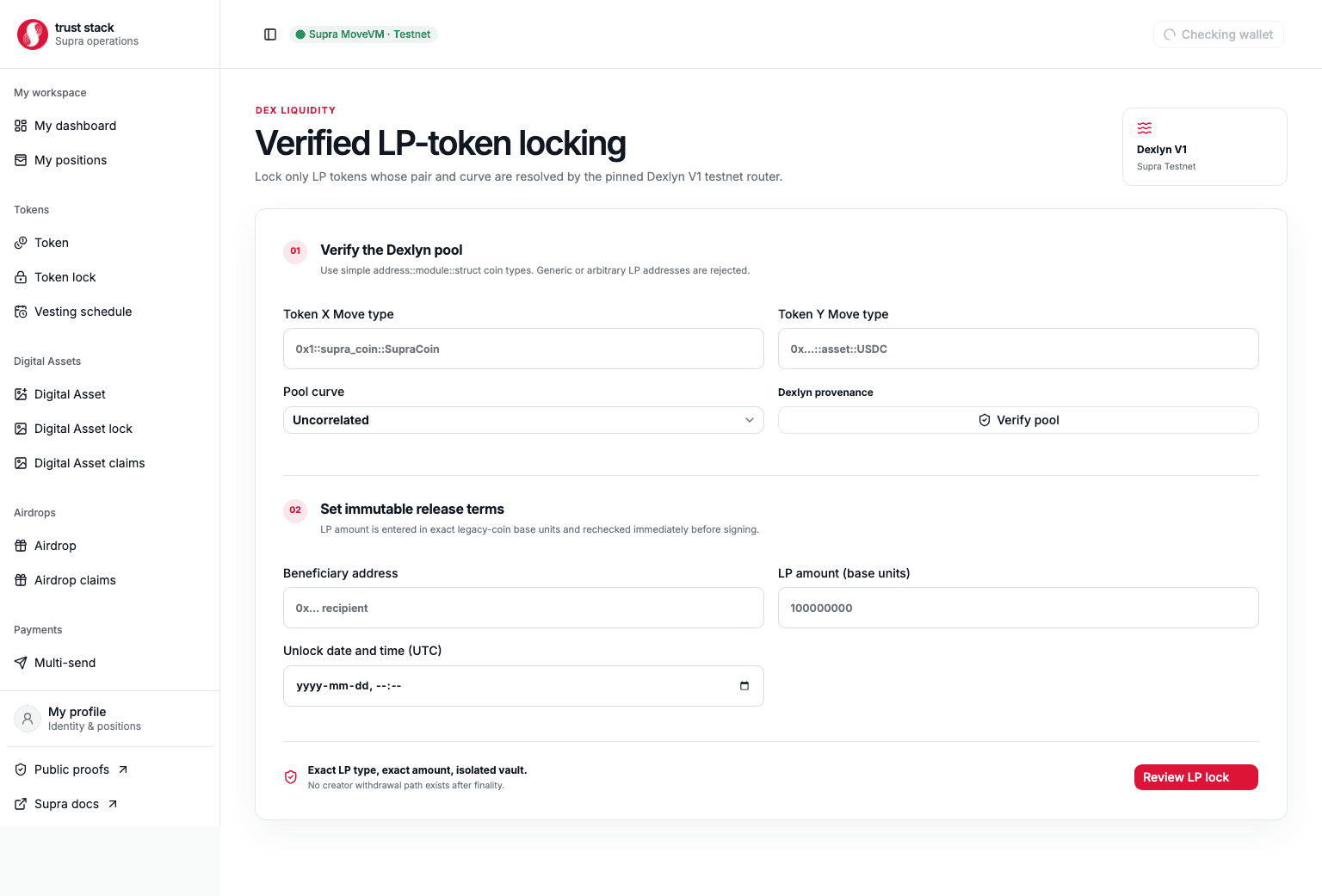
Create an LP lock
- Open Liquidity locks.
- Enter both underlying coin types and the exact curve type.
- Verify that type ordering identifies the intended Dexlyn V1 LP Coin.
- Enter the LP amount, beneficiary, and future unlock time.
- Review the typed asset, base units, vault balance, third-party dependency, and costs.
- Sign the lock transaction.
- Wait for the matching creation event and save the LP-lock object address and hash.
The adapter constructs a fixed generic function target from the reviewed types. It does not accept an arbitrary router or function target.
Practical example
A project owns 500 LP Coins for a Dexlyn TOKEN_A/TOKEN_B pool and locks all of them for its
community treasury until 1 January 2028.
- The project supplies the exact typed LP balance and pays creation gas.
- Trust Stack collects no protocol fee.
- The LP Coins remain in the lock vault until maturity.
- At maturity, the treasury beneficiary pays claim gas and receives the same typed LP Coins.
- Removing liquidity afterward is a separate Dexlyn operation with separate DEX behavior and costs.
Fees and costs
| Action | Trust Stack protocol fee | Who pays | Other cost |
|---|---|---|---|
| Create LP lock | None | Nobody | Creator supplies LP Coins and pays Supra network gas |
| Claim matured LP Coins | None | Beneficiary | Supra network gas |
| Verify an LP lock | None | Nobody | None |
| Add/remove liquidity or swap | Not a Trust Stack action | Dexlyn user | Dexlyn fees, price impact, slippage, and gas may apply |
Trust Stack does not take a percentage of the LP position. External Dexlyn fees or economic losses are outside the lock and should not be described as Trust Stack protocol fees. See Fee governance.
Claim
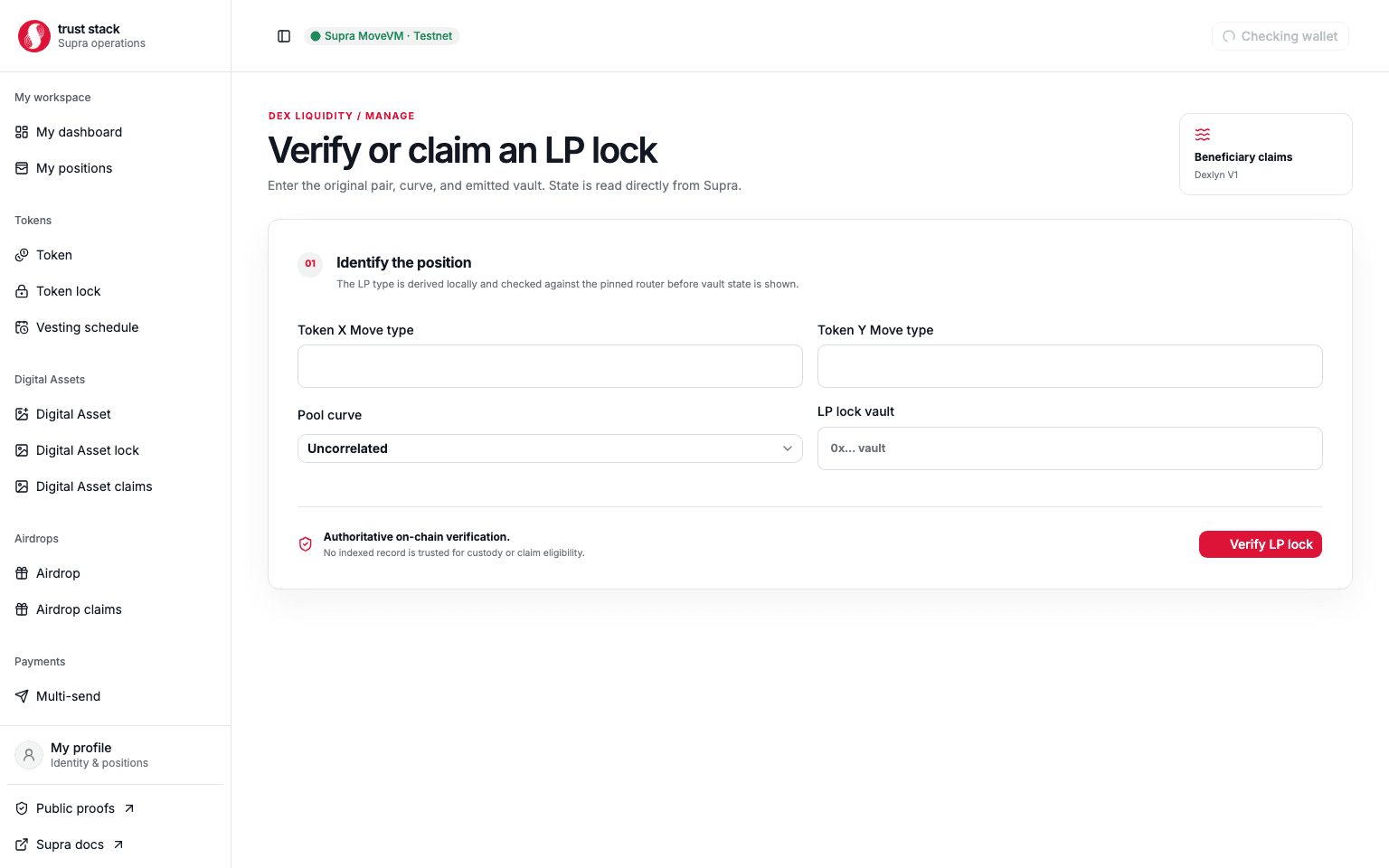
- Open Manage liquidity lock.
- Enter the lock object and the exact pool type parameters.
- Verify beneficiary, LP type identity, amount, deadline, claimed state, and vault balance.
- Connect the beneficiary wallet after maturity.
- Sign the claim and wait for the matching event.
- Confirm terminal state, zero expected vault balance, and receipt of the typed LP Coin.
What Trust Stack does and does not guarantee
Trust Stack checks the immutable lock terms, exact generic LP type, beneficiary authorization, maturity, claim state, and vault conservation. It does not audit the Dexlyn pool's reserves, underlying token issuers, price, impermanent loss, router, governance, or future upgrades.
Common problems
- Type mismatch: coin ordering and curve type must exactly match the LP Coin held by the wallet.
- No LP balance: adding liquidity is a separate prerequisite outside Trust Stack.
- Claim fails after maturity: verify the beneficiary, complete type parameters, and claimed state.
- Pool is unsafe or inactive: a valid lock does not certify the pool.
- LP value changed: the lock preserves LP units, not their market value or redemption output.
Third-party protocol boundary
The adapter is separately published at
0x899b43319d957a345b65667db7166e2e843c80433f55e1c79e427d2dbea203ba
under compatible upgrade policy. A real registered-pool positive lifecycle, upstream dependency
acceptance, and independent review remain required before meaningful use.