
Digital Asset locks
Hold one standard Supra Digital Asset for one beneficiary until an immutable time.
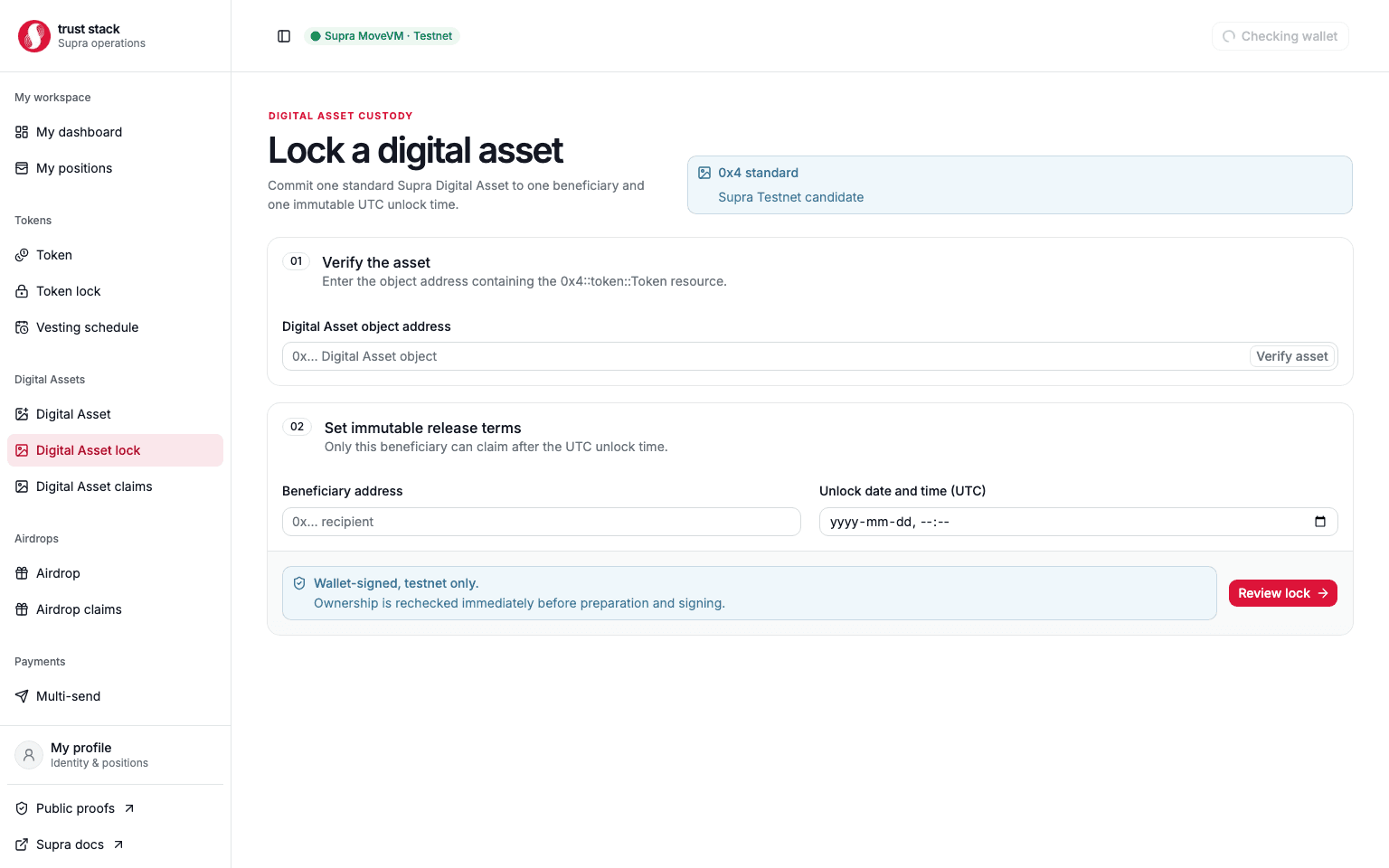
A Digital Asset lock transfers one standard object into a dedicated untransferable vault. The chosen beneficiary may release that exact object only at or after the immutable UTC unlock time.
When to use it
Use this product when one specific Digital Asset object—not a fungible token amount—must remain in vault custody until a public date. Examples include delayed delivery of a collectible, certificate, or one-of-one project asset.
Use token locks for Fungible Assets and liquidity locks for typed Dexlyn LP Coins.
Before you start
You need the Digital Asset object address, current ownership, final beneficiary, future UTC unlock time, and SUPRA for network gas. The object must be a supported standard Digital Asset and ordinary ungated transfer must currently be permitted.
Verify the complete object address, collection, name, media, transferability, and any issuer-retained framework capabilities before locking it.
Create a lock
- Open Create Digital Asset lock.
- Enter the Digital Asset object address.
- Verify its standard type, current owner, transferability, collection, name, and media.
- Enter the immutable beneficiary and future UTC unlock time.
- Review the exact object identity, vault custody policy, network, and costs.
- Sign the lock transaction.
- Wait for the matching creation event and save the lock-vault address and transaction hash.
The connected creator must own the asset. Vault creation and transfer of the object into custody happen in the same transaction.
Practical example
Alice owns Digital Asset object 0xabc... representing Launch Badge #1. She locks it for Bob
until 1 January 2028.
- The specific object
0xabc...moves into the new lock vault. - Alice pays network gas but no Trust Stack protocol fee.
- Alice cannot use the lock module to release it early or change Bob.
- At maturity, Bob signs the release, pays network gas, and becomes the object's owner.
The lock applies to that exact object address. Another object with the same name or media is not the same asset.
Fees and costs
| Action | Trust Stack protocol fee | Who pays | Other cost |
|---|---|---|---|
| Create Digital Asset lock | None | Nobody | Creator pays Supra network gas |
| Release matured asset | None | Beneficiary | Supra network gas |
| Verify lock and ownership | None | Nobody | None |
There is no fixed creation charge and no percentage deducted from the object. Digital Assets are non-fungible objects, so there is no token amount to reduce. See Fee governance.
Verify and release
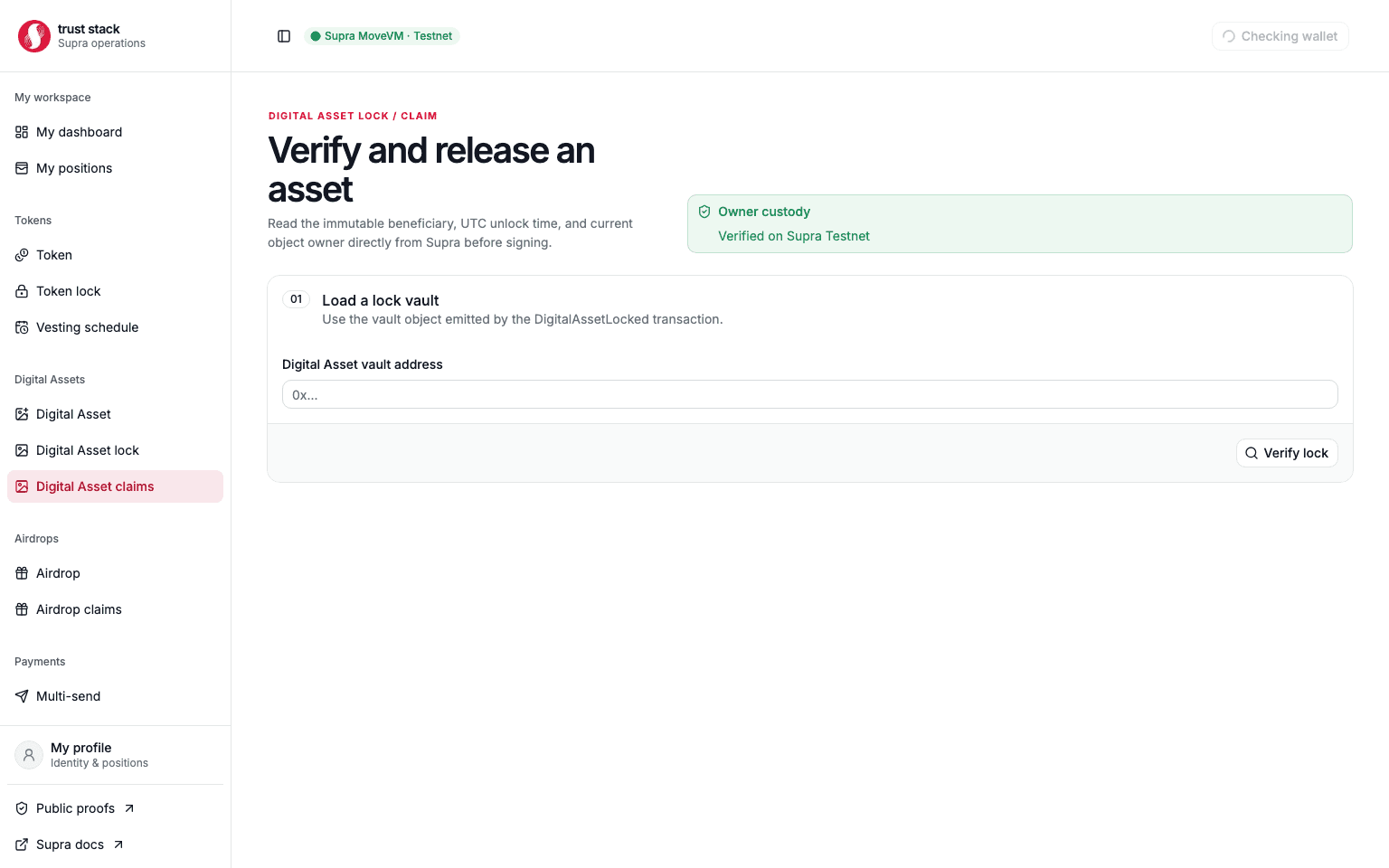
- Open Manage Digital Asset lock.
- Enter the lock-vault address and load authoritative on-chain state.
- Confirm the object address, current vault ownership, beneficiary, unlock time, and unclaimed state.
- Connect the beneficiary wallet after maturity.
- Sign Release and wait for the matching event.
- Confirm the lock is terminal, the vault no longer owns the object, and the beneficiary does.
The action remains unavailable for another wallet, before maturity, or after release.
What the lock guarantees
- One exact standard object is placed in isolated vault custody.
- Beneficiary and unlock time are immutable.
- Ordinary release through the lock is beneficiary-only and time-gated.
- The post-transaction check verifies final beneficiary ownership.
- A lock cannot release two objects or be claimed twice.
Important issuer boundary
A standard Digital Asset creator may have retained a framework TransferRef or another capability
outside this module. Trust Stack verifies ordinary vault custody but cannot prove that unrelated
issuer capabilities were destroyed. This is different from the Trust Stack Digital Asset factory,
which intentionally retains no issuer transfer reference.
Common problems
- Object not recognized: verify the full address and that it is a supported standard Digital Asset.
- Creator is not owner: connect the wallet shown by the current authoritative owner read.
- Transfer gated: the lock accepts only ordinary transferable objects.
- Release unavailable: confirm the beneficiary wallet and on-chain unlock timestamp.
- Same media, different object: always use the exact object address as identity.
Review issuer capabilities
Lock custody does not neutralize an external issuer capability that exists outside the lock module. Evaluate the asset's creation and authority policy before treating vault ownership as the only possible control path.